

As the new actual-play series season gains momentum, preparing for the concluding part of its opening act and splitting the cast members into three distinct parties, audiences are continuing to learn more about the enigmatic realm of Aramán, crafted by Dungeon Master Brennan Lee Mulligan. Exandria, the world of past seasons, drew extensively from well-known Dungeons & Dragons lore. In contrast, one of the most exciting aspects of Campaign 4 is how Mulligan plays with those common tropes to create something truly original.
A New Take on Celestials and Demons
Viewers have already encountered Aramán’s sad and twisted interpretation of the Celestials, but the third installment, titled “The Snipping of Shears,” also delivers some lore about their fiendish counterpart, the infernal creatures. This label has been used quite generically in the current season, but what’s most interesting is that it also refers to individuals that would be categorized as “tieflings” in traditional Dungeons & Dragons worlds, including the demon warlock Tyranny, played by Whitney Moore.
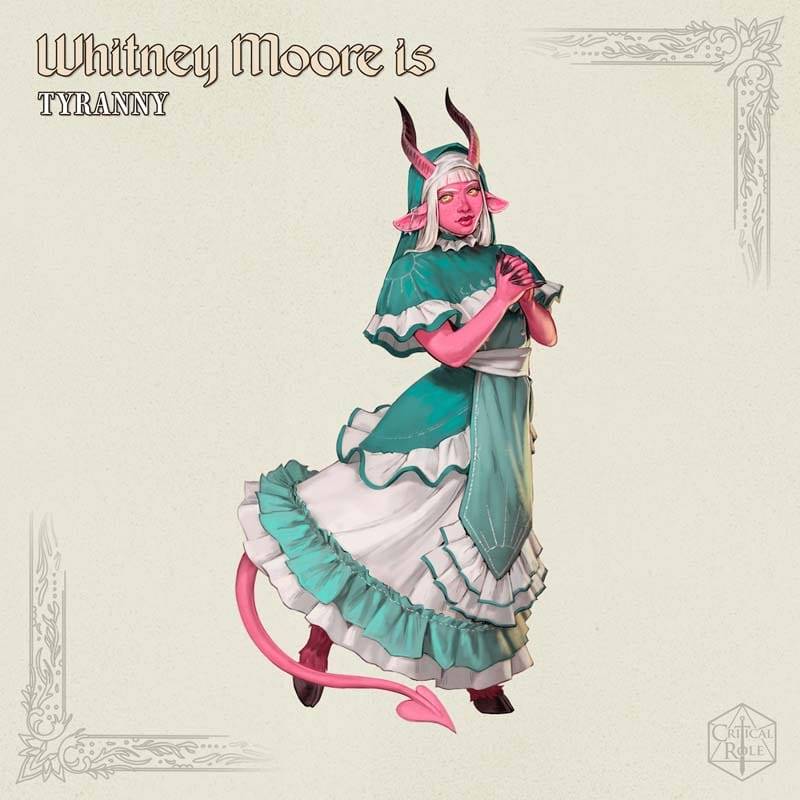
Traditionally, the fiend-touched race are humanoids with infernal heritage, but it appears that in Aramán, they’re true demons whose essences have come to inhabit a mortal body as the outcome of a deal. In the latest episode, it was revealed that demons reside in a realm called the Pit, ruled by an sinister entity called the Shadow of Suffering. Ksha'aravi struck a deal with House Halovar, in which he would provide them with infernal agents to use as agents and as paragons of redemption for the Candescent Creed. In exchange, he would get human spirits and some of the Filament, a material with holy qualities created by the the family.
Understanding the Fresh Mythology
If you are confused by this, many share your confusion. The Dungeon Master is a expert at hinting, and he’s being very careful about how much he discloses in each episode. Nevertheless, we can assume from what we know that Aramán’s fiend-blooded characters are demon souls who inhabit a mortal body. This is an interesting twist on one popular D&D character species, and one with the potential to make it more interesting.
The History of The Fiend-Touched
The origin of tieflings goes back to 1994 and the iconic Planescape Campaign Setting for second edition AD&D. They were loosely defined as mortals with extraplanar ancestry, suggesting it originated from devils, demons, or other evil planar beings. Planescape author Zeb Cook explained afterwards that he kept their background ambiguous on purposefully because he simply wanted to create an archetype for a reformed devil/antihero character, in part to attract the gothic and emo mindsets. Later versions of D&D, though, further defined and narrowed down those backgrounds (a decision that the creator criticized), resulting in the widely accepted view that these beings all have lineage that traces back to the infernal dimensions.

While the details about that heritage differ a lot, the common point is that tieflings are humans with the blood of Fiends in their ancestry. In D&D, infernal creatures are the inhabitants of the Lower Planes of malevolent nature, including the the chaotic void, the the infernal realm, the prison plane, the fiery pit, Pandemonium, and probably a few more that are often overlooked. This cosmology is common to almost all D&D settings, including the previous campaign setting, which has had its ample number of Fiend appearances. While these evil creatures are originate from the Lower Planes, they can be called forth to the mortal world or access it through gateways. They come through with their corporeal forms, but they can only be permanently killed on their native planes.
Breaking with Convention
The portrayal of the infernal domain and its inhabitants made in episode 3 of Campaign 4 steers away from these common elements. Ksha'aravi strongly resembles Asmodeus, the sovereign of the Nine Hells, with all that scheming and soul bargaining, but it seems is that the demons of Aramán do not have a solid form, or at least one they can use to enter the “Material Plane” (or however it’s called in the setting). Tyranny specifically says in that episode that she was “provided with a form” just six months ago, and previously she was just a “drifting spirit” in the Pit, so this seems to be the origins of tieflings in this new setting (upcoming installments may show traditional tieflings actually exist, but given that this character is a main cast member, this is improbable).
The Creator’s Intent
Returning to Zeb Cook’s interview, he explained that he created tieflings to play a specific role: the afflicted, quasi-damned protagonist, that wasn’t represented in D&D's epic fantasy-focused roster of options at the time. Planescape co-writer Colin McComb added in that discussion that "Tieflings resonate because they're brooding and intense. They've got an automatic built-in secret. They're outsiders and loners, and they have a valid cause to shun society (and be rejected by them).” Over the years, however, the gloom that was baked into the background of tieflings faded away, and they simply became a very popular playable race with some extra spells and a striking, unique appearance.
Returning to the Edge
There’s nothing wrong with that. You can portray a cheerful fiend-blooded character who doesn’t think for a second about their infernal heritage, if that suits your style. Nevertheless, it’s believed that Brennan Lee Mulligan’s version shines exactly because it doubles down on that “dark” beginning, making it an integral part of the persona. By all intents and purposes, Tyranny and her sisters have a form only because of Ksha'aravi’s dealings with the Halovars. When she has the inevitable emancipation arc, freeing herself from the chains of her demonic brethren, it will seem impactful and intense because her character species’ origin is woven into the setting’s lore.
Looking Ahead
In addition to this fresh perspective at the fiend-touched, many are eager to discover additional details the infernal realm and Aramán demons. Fans are enthusiasts for D&D’s cosmology, particularly the mythology of the Lower Planes. One could study about conflicts in the infernal kingdom, fights among fiendish rulers, and the enigmatic beginnings of the yugoloth all day. However, this lore is fairly uniform in every D&D setting, so there is anticipation for some fresh, significant expansion to it.


